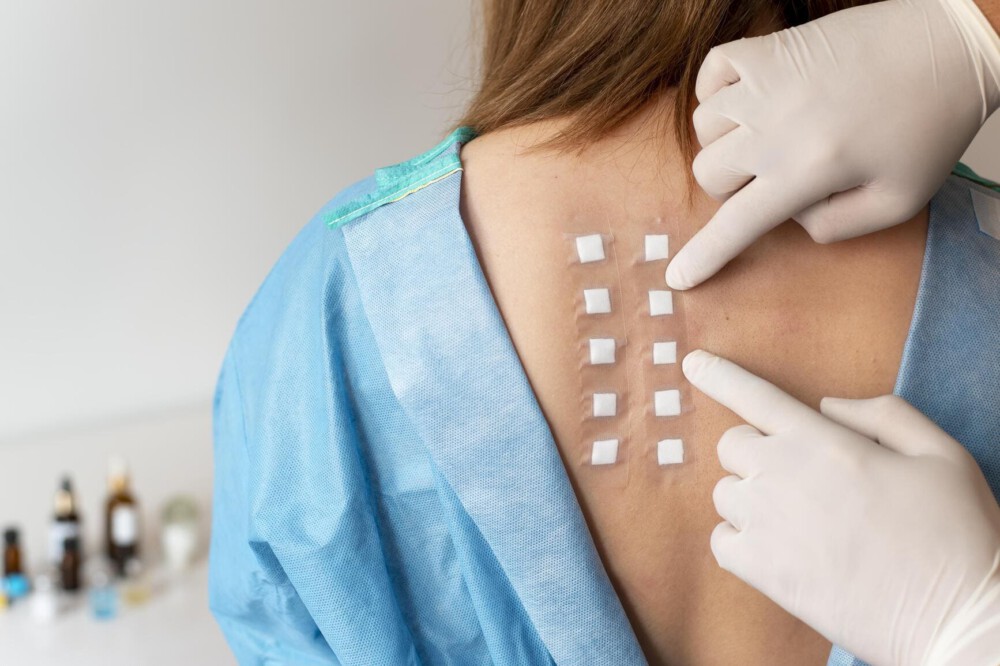
Different In vivo tests can be used to assess the skin tolerance of a cosmetic product depending on what we want to evaluate.
The most common of skin tolerance In vivo tests are:
- PATCH TEST: assesses irritant capacity
- HRIPT (Human Repeated Insult Patch Test): assesses allergenic ability
- OPEN TEST: assesses immediate irritancy/allergenicity
- COMEDOGENICITY TEST: evaluates, in acne-prone skin, the comedogenicity by a dermatologist.
- USE TEST: evaluates skin tolerance during continuous use of the product under dermatological control. It is often followed by a questionnaire to evaluate both the tolerance and the subjective efficacy of the product.
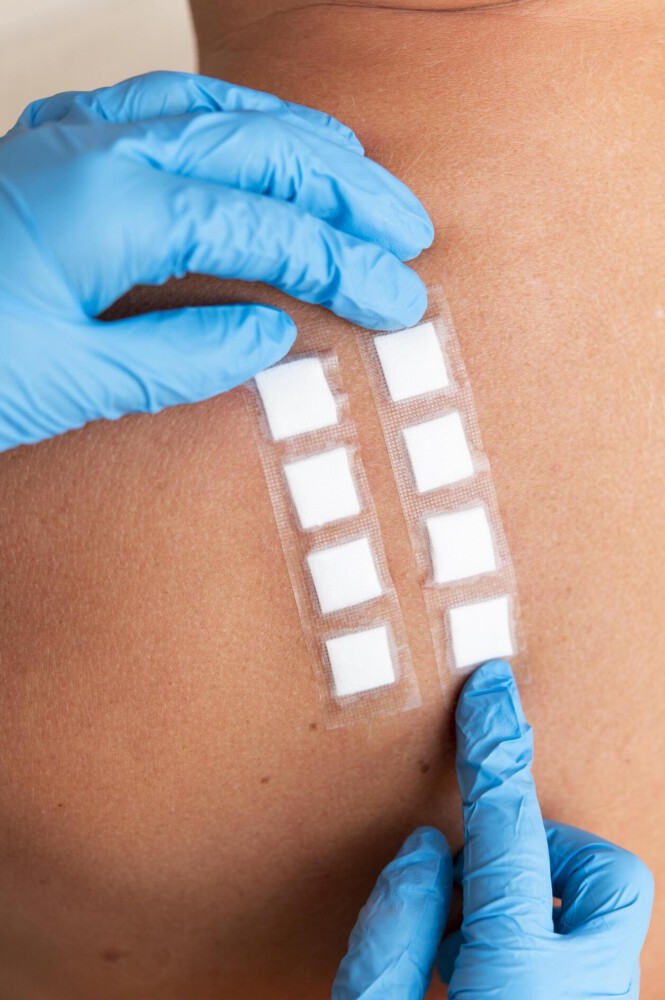 Among these tests, the most commonly used to determine the irritation potential of a cosmetic is the Patch Test.
This type of test verifies the compatibility of a cosmetic product after a single application of the product in occlusion (under patch), under dermatological control.
Depending on the type of cosmetic to be tested, occlusive patches or semi-occlusive patches can be used (e.g. in the case of fragrances with a high alcohol content).
The patches are made up of 10 chambers. The products are placed in the chambers, leaving an empty chamber as a control. The 10 chambers are mounted on a tape that is stuck to the back of the volunteers.
The minimum number of volunteers recommended to carry out a Patch Test is 10 volunteers, and it can be performed on panels of all skin types or on specific panels of sensitive skin.
The patches are removed after 48 hours of application. A first reading is taken 15 minutes after patch removal and a second reading is recommended after 72 hours to verify the results of the first reading.
Depending on the degree of irritant response a value will be given:
- ➖ No irritant response
- ➕ Erythema with slight oedema
- ➕➕ Erythema with oedema and vesicles
- ➕➕➕ Erythema with coalescing oedema and vesicles
IR Any irritant response (reflectivity, pustules, blisters, dryness/desquamation, detergent effect).
Interpretation of the results
The Mean Irritation Index (M.I.I.) is calculated as follows:
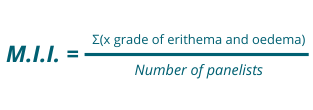
M.I.I. = 0,00 Non-Irritant / Very Good Skin Compatibility
M.I.I. < 0,20 Non-Irritant / Good Skin Compatibility
0,20 < M.I.I. < 0,50 Slightly Irritant / Intermediate Skin Compatibility
0,50 < M.I.I. < 1,00 Moderate Irritant / Poor Skin Compatibility
M.I.I > 1,00 Irritant / Very Poor Skin Compatibility
Discover the 4 key steps to register a cosmetic product sucessfully in our ebook. Download it for free here!